

Why your landing page gets no leads: offer, form and traffic
Test the complete enquiry journey first
If a landing page gets no leads, test four connections before commissioning a redesign: relevant visit, clear offer, usable form and delivery to the person who handles enquiries. Send a labelled test from a phone, compare the advertisement with the first screen and check which visitors reach the form. Fix a demonstrated cause, then measure again. A lack of leads alone does not identify a design problem.
This approach works for a new campaign or an established page. It separates website faults from unsuitable traffic and measurement errors. An analytics dashboard can record a conversion even when the sales team receives nothing, so start with an actual enquiry rather than a report alone.
Define the problem and the evidence
Agree what counts as a lead: successful form submission, completed call, message or booked conversation. These are different actions. Clicking a telephone link does not prove a call took place, and opening a form does not prove it was submitted. Compare analytics with inbox or CRM records for the same period.
Record the page URL, campaign dates, source, country, language, device and confirmed enquiries. Separate staff visits, test submissions, spam and duplicates. A small number of relevant visits may be insufficient to judge the page. There is no conversion percentage that every business landing page must achieve: the audience, offer, acquisition source and definition of a lead all matter.
- Open the exact destination used in the advertisement.
- Compare visitors and periods with equivalent conditions.
- Write down one observed problem and the evidence that would demonstrate its resolution.
For a European business, define the actual countries and languages served instead of treating Europe as one audience. A campaign for one market may need different evidence, contact options and commercial details from an international campaign.
Match the offer to the buyer’s intent
A visitor needs to understand what you provide, who it is for, what the engagement includes and how to start. A headline such as “Solutions for your success” leaves those questions unanswered. Describe the service and its boundaries in concrete language. A “from” price is useful only when the included scope and pricing factors are clear.
Compare the advertisement and the page for the service, conditions and next action. If an ad offers a project estimate, the page should explain what information is needed for that estimate. Someone seeking maintenance for an existing store may not want a completely new website. Keep the advertisement, page, form and expected response in the intended language.
Consider an illustrative situation: an ad promotes one landing page service, but the destination lists eight unrelated services without a clear priority. The useful change is to clarify the relevant offer and scope, rather than simply enlarge the button. This is a diagnostic example, not a claimed client result.
If the evidence points to a new page, a landing page development agency should begin with audience, offer and acceptance criteria. Agree which materials substantiate the claims before approving custom landing page design.
Check whether the traffic is suitable
More visits do not necessarily mean more prospective customers. Review actual search terms, placements, location, language and devices. Some service-related searches are informational: the visitor wants a template or instructions rather than a supplier. Segment the data before rejecting a channel, and first confirm that tracking works.
Follow the live advertising link on a phone. Check redirects, parameters, language selection and availability. Do not combine unrelated countries into one conclusion. Reviewing the page together with PPC campaign settings helps distinguish a message problem from a targeting problem. Visual redesign cannot make an irrelevant search term commercially suitable.
Use advertising account evidence and confirmed enquiries. Do not buy extra visits merely to build a larger sample while a submission fault remains unresolved. Keep a change log with date, hypothesis and changed element so later observations have context.
Use the form as a first-time visitor
Test on an ordinary phone without saved contact details. Can you read the offer, reach the button and enter a telephone number? Do cookie controls or a floating contact widget cover the fields? Are labels, validation messages and confirmation visible? Country selection, autofill and input masks must accept the intended customers’ details.
Ask only for information required to begin a conversation. A compulsory long technical brief can prevent an otherwise suitable client from enquiring. Explain why the contact is needed and what happens after submission. Keep privacy information readable and consent behaviour consistent with the implemented process.
Test unsuccessful paths as well: a missing required field, invalid email address, international number, repeated tap and temporary failure. The interface should explain the correction and preserve the message. Avoid invented urgency and response promises the business cannot support.
Confirm that someone receives the enquiry
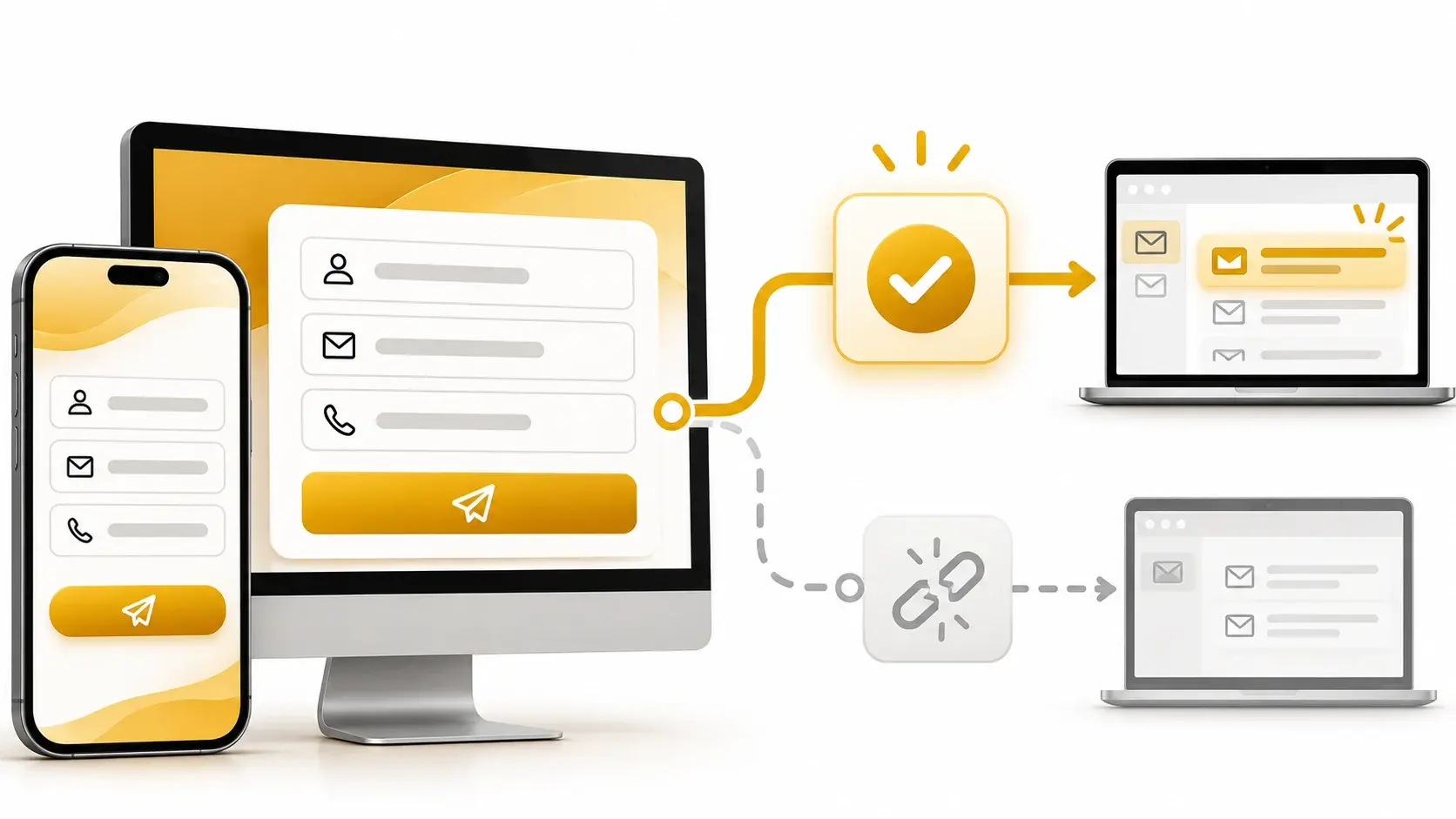
A thank-you screen shows an interface response; it does not independently prove delivery. Send a clearly labelled test and check the agreed destination: email, CRM or another operational channel. Verify the contact, message, originating page and source. Exclude the test from commercial reporting afterwards.
For a CRM workflow, agree ownership, duplicate handling and how an integration failure becomes visible. Creating a record is not enough if the recipient lacks the information needed to respond. Our guide to preparing a website–CRM integration explains field mapping, responsibility and failure scenarios.
Measurement may be incomplete when visitors decline optional analytics. This should not prevent the core enquiry function from working. Compare available operational records with analytics while recognising that consent can affect the observed totals.
Prioritise fixes by the observed failure
| Observation | First check | Next action |
|---|---|---|
| A test enquiry never arrives | Form handler and destination | Restore delivery before buying more traffic |
| The ad and page promise different things | Search term, advertisement and first screen | Align the offer and next action |
| The form is difficult on mobile | Fields, keyboard, overlays and errors | Remove the demonstrated obstacles |
| Visitors are not prospective buyers | Terms, placements, language and location | Review campaign targeting |
| The journey works but evidence is limited | Volume and quality of observations | Continue measuring before redesigning |
This is an investigation order, not a promise of higher conversion. Fix failures that block enquiries before polishing presentation. Once the journey works, test whether clearer scope, evidence or next-step wording helps the intended audience.
Accept changes with repeatable checks
Keep a short acceptance record: original fault, change, device, URL, expected behaviour and confirmed receipt. Repeat the process in each language and for the main contact channels. Check that links reach live destinations, mobile content does not overflow and headings or images do not cover the form.
- Follow the advertisement to the intended offer.
- Submit tests from desktop and mobile.
- Confirm delivery and the accuracy of the fields.
- Match the analytics event to the actual action.
- Assign responsibility for checking the journey after future changes.
Use the website brief and acceptance checklist to make these requirements explicit. Conversion landing page development should solve a verified business problem. Sometimes a form repair and clearer offer are sufficient; sometimes the page structure needs replacing. Choose the scope from the diagnosis rather than from an assumed need for a new design.
Find where enquiries are being lost
Send the landing page URL, an example advertisement and the enquiry you want to receive. We can discuss which checks and changes should come first.
Discuss your landing page