


Business website costs: compare quotes and plan year one
Compare the scope before the total
A business website budget includes the build, content, connections and costs after launch. Two quotes are comparable only when they cover the same pages, languages, functions and acceptance checks. Separate the one-off project from recurring domain, platform or hosting, third-party subscriptions and agreed maintenance. A starting price describes an entry scope; it is not the final price for every business requirement.
For a company in Moldova or a business serving international customers, start with the visitor's task: request an estimate, compare a service or place an order. Ask suppliers to cost that same journey. Comparing two offers described only as a “complete website” leaves too much room for different assumptions about what complete means.
What a website development quote should include
At publication, AV Group lists these starting build prices: business-card website from €500, landing page from €700, corporate website from €1,200, multipage website from €1,500 and online store from €2,000. Custom work is scoped individually. These are format-level starting points, not an all-inclusive price for an unspecified project. Check the current website development service and agree the actual deliverables before work begins.
Page count is only one part of the workload. A single page with a calculator, several enquiry routes and a data connection may involve more work than a few simple information pages. Reusing an agreed service-page template also differs from designing every section independently.
| Quote component | What should be defined | What needs clarification |
|---|---|---|
| Structure and design | Pages, unique templates and responsive states | Approval stages and who signs off the structure |
| Content | Who writes, edits and uploads text and images | Translation, photography and content licences |
| Functionality | Required forms, search, filters, catalogue or account features | Special logic and failure handling |
| Connections | Named systems, data fields and acceptance checks | External subscriptions and available APIs |
| Launch | Publishing, domain connection, form tests and basic SEO setup | Existing URL migration and editor training |
A short website brief with acceptance criteria makes these assumptions visible. Give each supplier the same version rather than comparing estimates produced from different conversations. A shared brief also makes it easier to identify what has deliberately been excluded.
Put competing proposals on the same basis
Use one comparison sheet and ask each supplier to mark an item as included, excluded or still to be estimated. Missing information is not a zero-cost item. “CRM integration” is not a comparable deliverable until the system, fields, destination and lead-delivery test are specified.
| Comparison point | Proposal A | Proposal B |
|---|---|---|
| Pages and languages | Exact list of deliverables | The same list or explicit differences |
| Copy and images | Owner and quantity of materials | Owner and quantity of materials |
| Forms and integrations | Submission route, recipient and test | Equivalent route and testing depth |
| Revisions and acceptance | Approval stages and completion evidence | Approval stages and completion evidence |
| After launch | Corrections covered, period and conditions | Equivalent coverage or a separate service |
| Ownership and access | Domain, project and service account owners | Handover and editing conditions |
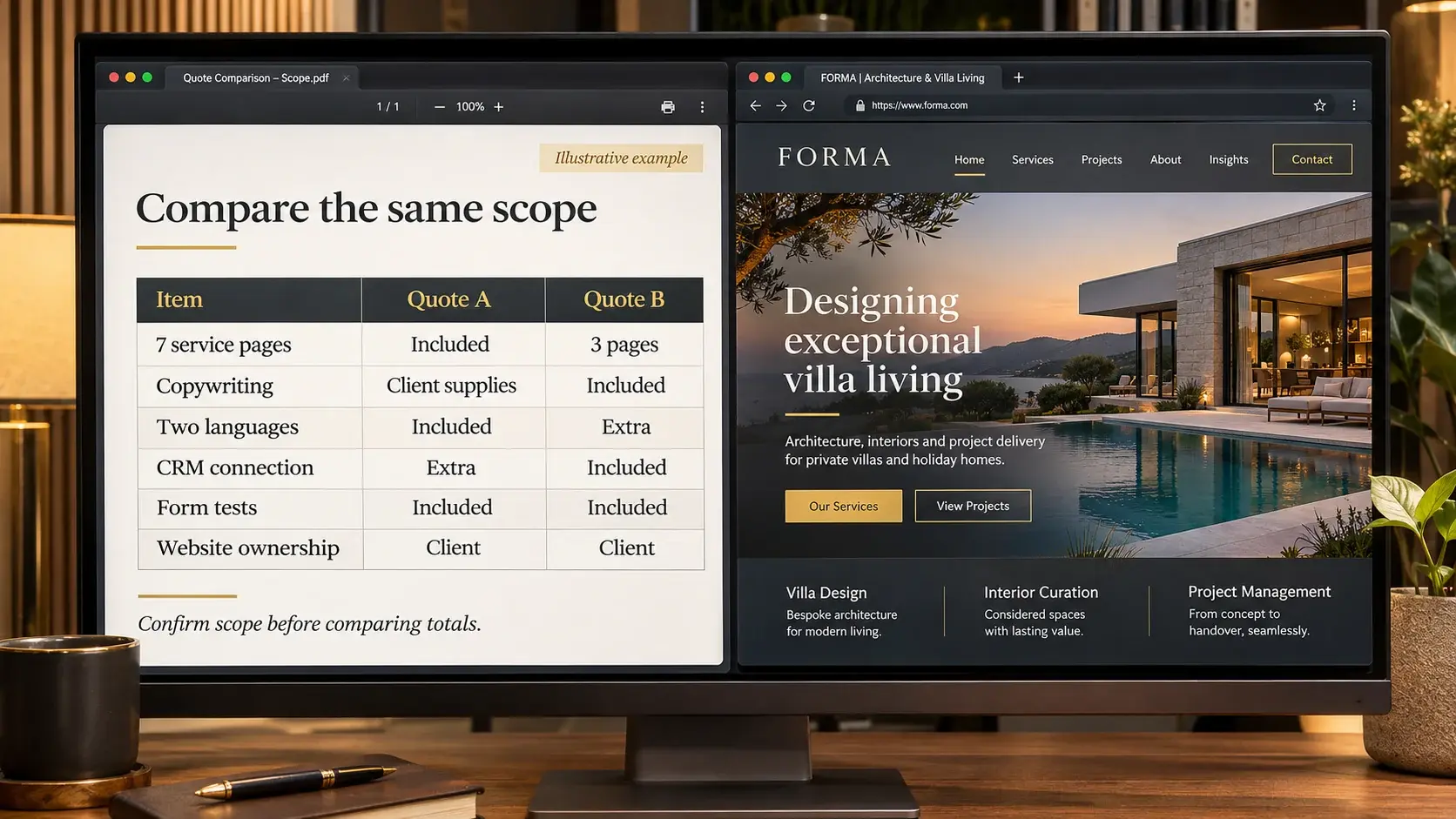
For example, one proposal might cover seven pages in two languages using client-supplied copy. Another might include three pages and copy preparation, but charge separately for the second language. The same total would still buy different deliverables. Normalise the scope before judging the price or deadline. This is a comparison example, not a client project's budget or result.
Ask for the currency, payment stages, treatment of applicable taxes and how changes are priced. The headline starting rate does not settle those questions. For multilingual work, include navigation, forms, notifications and page metadata in the scope: translating body copy alone does not produce a finished language version.
Budget for the first year, not just launch day
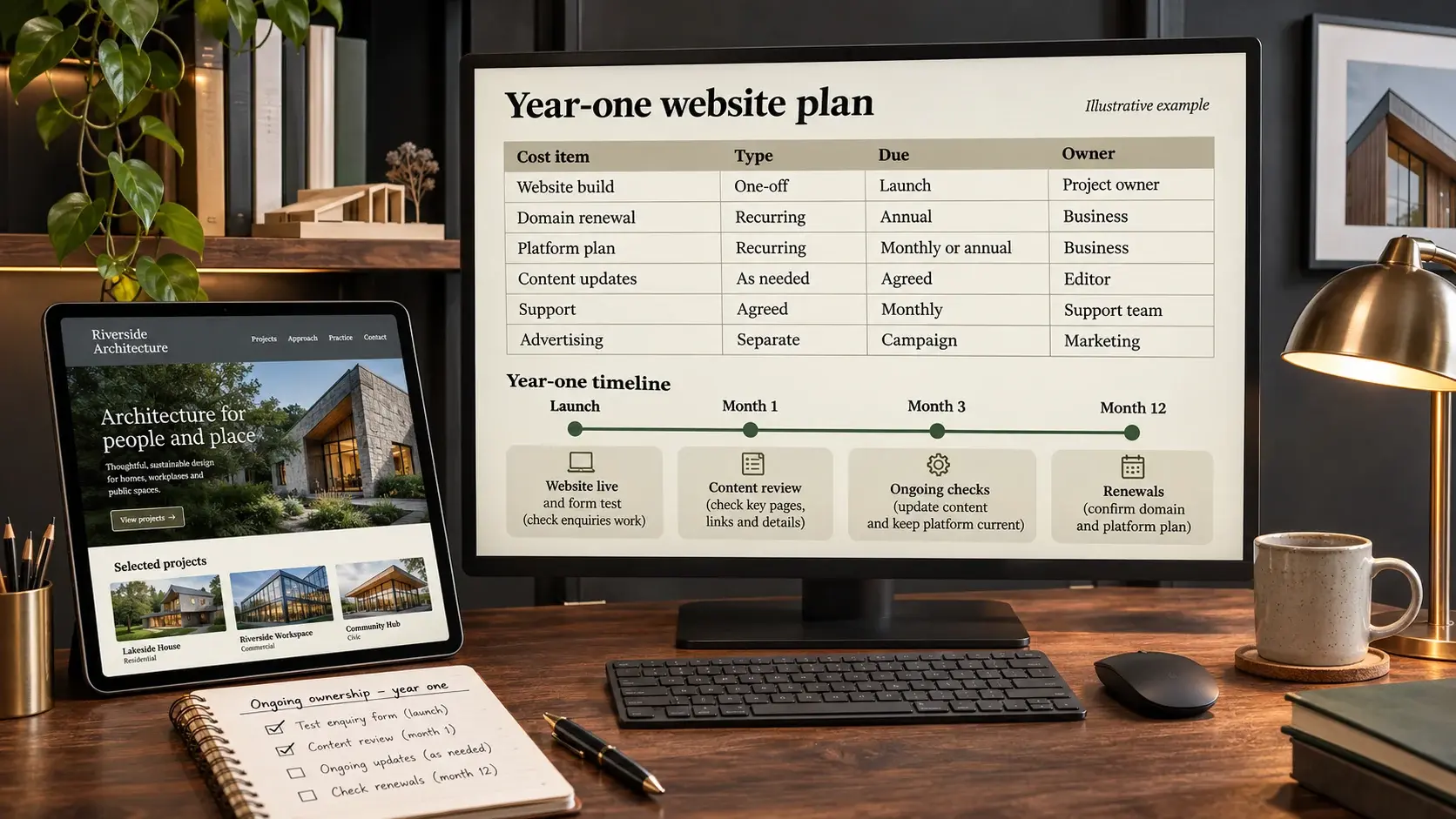
Group costs by who pays them and when they become due. The build is generally a one-off project; domains, the publishing platform and connected subscriptions may renew. Maintenance, new content and promotion depend on the selected scope and should not silently be assumed to be part of “launch”.
| Cost item | How to budget | What to check |
|---|---|---|
| Website build | Agreed one-off estimate | Mandatory journeys are included |
| Domain | Registration and any renewal falling inside the period | Owner, renewal date and next-period charge |
| Platform or hosting | Payments for the selected term | Do not count monthly and annual billing twice |
| Connected services | Subscriptions and usage charges where applicable | CRM, email, forms, payment and other connections |
| Content and maintenance | Agreed tasks or retainer scope | Limits, responsibilities and out-of-scope work |
| Promotion | Separate SEO or advertising plan | Agency work is separate from media spend |
A useful model is: first-year budget = launch work + recurring payments for the actual period + agreed updates + separately selected promotion. Do not count a subscription again if the estimate already includes it. A change reserve can be a sensible planning choice, but there is no meaningful universal percentage without knowing the project.
Platforms differ in billing terms and feature coverage. For instance, Tilda's official pricing page distinguishes monthly and annual billing. Check the current plan, currency and required features during scoping rather than copying an old figure from an article. Do the same for any connected service that will create a recurring charge.
Three scope decisions that change the workload
A bilingual service website. Budget for the agreed pages, translation, editing, forms and language-switch checks. A smaller first release can prioritise the most important services and reuse an approved page template. Leaving published pages half translated is not an equivalent way to reduce the scope.
A catalogue that collects enquiries instead of taking payment. Product cards, filters, data entry and enquiry delivery still need to be scoped. If checkout is not currently required, it does not need to be commissioned just in case. The catalogue still needs a content owner to supply names, photographs, specifications and prices in an agreed format.
An existing multipage website. Page inventory, content migration and useful existing URLs become material parts of the project. The InSpecCom corporate website case illustrates how services, equipment and project material can form a connected structure. It helps explain content organisation; it does not disclose the project budget or set a price for another company.
Separate the essential launch from later development. Phase one should include what a visitor needs to choose a service and get in touch, and what the team needs to receive that enquiry. Put later additions into a defined backlog with dependencies. This reduces initial scope while preserving the quality of the essential journey.
Agree ownership and acceptance before signing
Connect the schedule to content delivery and approvals. If photographs, translations or product data are not ready, ask how that affects the timeline. Appoint a decision maker on the client side: conflicting approvals can create avoidable rework, even when everyone is trying to improve the result.
- One list covers pages, languages, templates and mandatory features.
- A named person owns text, images and catalogue data.
- Forms are tested on phone and desktop, and the intended recipient receives the enquiry.
- Domain ownership, platform access and handover conditions are clear.
- Fixing an agreed requirement is distinguished from commissioning a new feature.
- Recurring charges, renewal responsibility and ongoing website maintenance are understood.
Ask the supplier to demonstrate the actual journey: find a service, understand the offer, send an enquiry and confirm receipt. An attractive layout and successful enquiry delivery are separate acceptance items. The checks should reflect your project rather than a generic list that nobody will use.
For an initial estimate, bring the business context, page list, required languages and functions, available content and target launch date. The supplier can then ask specific questions and identify items that still need investigation. A useful quote describes both the price and the result you can verify for that price.
Get a scope-based website estimate
Send the page list, required languages and functions, your existing website and available content. We will separate launch work, recurring costs and optional later stages.
Discuss your website budget